WHY THIS MATTERS NOW
Real inclusion isn't a service you receive. It's a role you hold.
In the United States, the employment gap between people with disabilities and those without remains stark. In 2024, only 22.7% of people with disabilities were employed, compared to 65.5% of non-disabled people. Most programs meant to close that gap survive one grant cycle at a time. When a foundation tightens its budget to protect itself, the cut lands on the recipient's board — and from there, on the rural patients whose care depended on funding that could not be guaranteed.
At the same time, farmland ownership is consolidating. In Oregon, institutional buyers and low inventory have pushed land prices up faster than local farmers can keep up. When ownership concentrates outside the community, so does the decision-making about how that land gets used.
Altera Studio's curriculum offers one model: shared land ownership, inclusive work, and revenue that stays local. It draws on a proven European precedent, a cooperative structure that integrates people with disabilities directly into productive enterprise, not as a side program, but as the business model itself.
Here's an example of what students exploring this model could build:
- A therapy-enterprise hybrid. A center where neurodivergent and physically disabled adults and youth will work as members of the enterprise, not just recipients of care, contributing according to their abilities and building on research-backed benefits of work-based inclusion.
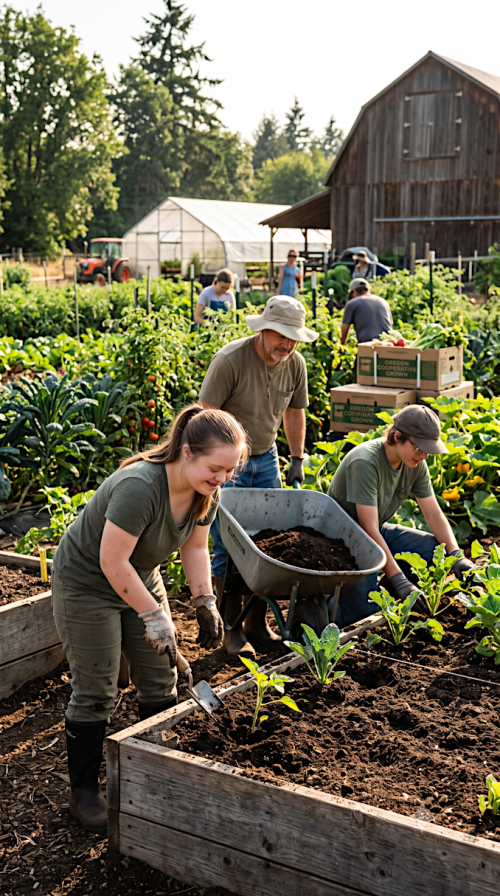
- Community-sustained agriculture. Farmland leased to or owned by the cooperative will generate independent revenue, directly support care operations, and reduce reliance on annual grant cycles.
- Local governance. Leadership and asset ownership will stay with the people building the enterprise, keeping the mission aligned with the community it serves and giving investors a stable, mission-locked partner, with roles and oversight kept distinct.
WHAT WE BUILD, AND HOW YOU GET THERE
For Credit Unions: A Relationship That Starts Before the Pitch
Most credit unions meet a potential member the day they need a product — a loan, an account, something already decided. This model starts earlier. You sponsor Altera Studio and support instruction inside it, so your members build a relationship with you months before any account is opened. By the time a cohort reaches the "Sustaining" level of instruction, they will see you as a partner, not just an institution asking for their business.
Behind that relationship sits technology built specifically to support it. As members move through Altera Studio toward founding a social cooperative of their own, the same platform keeps you and them connected at every stage, tracking progress, surfacing contributions, and making capital and participation visible rather than hidden in separate systems.
The result is loyalty earned before it's needed, and a credit union positioned as the natural financial partner for a cooperative your members helped build from the ground up.


© 2026 The Rose Encoded, LLC · theroseencoded.com · Portland, Oregon. The Rose Encoded, LLC is a technology provider. It does not accept deposits, exchange currency, or issue financial products. The products described here are in development and, when available, will be offered by partner credit unions, subject to applicable federal and state regulations. Contributions to The Rose Encoded are donations that support software development. They are not deposits, investments, or purchases, and they confer no financial product, interest, return, or ownership stake of any kind.